1 Vale of Glamorgan Deposit Replacement Local Development Plan
5.1 The RLDP strategy identifies broad areas where new development will occur in order to achieve the Vision and Objectives set out earlier in the Plan. The strategy has been developed with full regard to:
- The national, regional and local policy context.
- The key social, economic, environmental, and cultural issues relevant to the Vale of Glamorgan.
- The adopted LDP Review Report.
- Issues identified in the Annual Monitoring Reports for the adopted LDP.
- A range of population, household, dwelling and employment growth scenarios.
- The latest Local Housing Market Assessment.
- The Settlements Appraisal Review.
- The Integrated Sustainability Appraisal Scoping Report and assessment of Alternative Options.
- Stakeholder engagement and involvement on the Vision, Issues and Objectives, Spatial Strategy Options and Growth Options; and
- Regional discussions on the level of growth in the context of Future Wales.
5.2 The ten strategic objectives identified in Section 4 have significantly influenced the development of the Strategy. It seeks to balance the need for growth (Objective 3 - Homes for All, Objective 9 - Building a Prosperous and Green Economy) with the need to protect the Vale of Glamorgan’s distinctive natural and built environment (Objective 5 - Protecting and Enhancing the Natural Environment, Objective 6 – Embracing Culture and Heritage).
5.3 In line with the Council’s declaration of a Climate Emergency, the role of planning in mitigating and adapting to climate change (Objective 1 – Mitigating and Adapting to Climate Change) is integral to the RLDP. The strategy seeks, wherever possible, to favour the re-use of previously developed land, avoid areas of flood risk and promote a range and choice of new housing and employment sites in sustainable locations with good access to employment, public transport, community facilities and shops (Objective 8 - Promoting Active and Sustainable Travel Choices).
5.4 Placemaking, through the creation of active, safe and accessible places that contain a range of uses, is at the heart of the strategy (Objective 4 – Placemaking). This will ensure that the plan creates communities that will improve well-being (Objective 2 - Improving Mental and Physical Health and Well-being). Regeneration and the diversification of town centres in line with Town Centre First principles will be an integral part of creating vibrant communities (Objective 7 - Fostering Diverse, Vibrant, and Connected Communities).
5.5 In addition, the strategy recognises the potential economic benefits that can arise from the promotion of appropriate sustainable tourism (Objective 10 – Promoting Sustainable Tourism), strengthening the local economy through job creation, supporting local businesses, diversifying the economy and ensuring that money stays within communities.
5.6 The RLDP Sustainable Growth Strategy comprises six key elements as follows:
- Delivering a sustainable level of housing and employment growth supported by appropriate infrastructure that accords with the Vale’s position within the Cardiff Capital Region (CCR).
- Aligning locations for new housing, employment, services and facilities to reduce the need to travel.
- Focusing development at locations that are well served by existing and proposed rail stations as part of the South Wales Metro and in areas with good bus links.
- Allowing for small scale affordable housing led development in settlements outside the Strategic Growth Area at a scale proportionate to the size of settlement.
- Supporting the role of Cardiff Airport as a strategic gateway for international connectivity.
- Allowing for regeneration opportunities on previously developed and under-utilised land, including at Aberthaw and Barry Docks.
- Delivering a sustainable level of housing and employment growth to accord with the Vale’s position within the Cardiff Capital Region. View representations
5.7 To meet the aspirations contained within the overarching Vision, the Council shall seek to deliver a sustainable level of growth that will meet the identified future housing and employment needs and which are complimentary to the wider growth aspirations of the South East Wales Region as detailed within Future Wales. As such the RLDP will make provision for:
- A housing requirement of 7,890 dwellings over the plan period or 526 dwellings per annum, plus a flexibility allowance.
- An allocation of 182 Ha of employment land across a range of sites to enable 67.8 Ha to be brought forward during the plan period and the delivery of up to 5,338 jobs.
5.8 The level of growth proposed is based on average completions over the first ten years of the adopted plan period (526 dwellings per annum). This reflects an appropriate timeframe, encompassing a period of low housing completions following the economic recession and the more recent boom years following the adoption of the LDP and delivery of allocated sites. This level of growth has been demonstrated to be deliverable and is sufficiently ambitious to reflect the Vale’s position in the Future Wales national growth area. It also addresses the acute need for affordable housing, whilst being achievable within the limitations of the natural and built environment.
5.9 This level of growth will strive to deliver a population balance by bolstering the working and school age populations to offset the Vale’s ageing population. This will be achieved by providing a range of housing and employment opportunities to encourage existing residents to live and work in the Vale (reducing out-migration and out-commuting) and as well as encouraging the in-migration of new residents, but at a level that is complementary to, rather than competing with, the neighbouring authority of Cardiff and the wider Cardiff Capital Region (CCR).
5.10 The scale of employment provision is balanced with the level of population growth to seek to reduce commuting.
- Aligning locations for new housing, employment, services and facilities to reduce the need to travel. View representations
5.11 A key priority of Llwybr Newydd – the Wales Transport Strategy is to bring services to people to reduce the need to travel and the dependency on private cars. The spatial strategy will seek to locate major new development in places that are well served by services and facilities in accordance with the findings of the Settlements Appraisal Review.
5.12 The level of growth proposed within settlements must be sustainable and in the right locations, having regard for the role and function of settlements, the Settlements Appraisal Review and the capacity of settlements to accommodate further growth.
5.13 The Vale has several established business parks and industrial estates that offer a range of employment opportunities. The businesses within the Cardiff Airport and Bro Tathan Enterprise Zone provide a range of high-quality jobs, with further development opportunities anticipated to be delivered during the plan period. New housing development will therefore be focused on St Athan and Rhoose as key development opportunities to capitalise on their proximity to the Enterprise Zone.
5.14 While the plan will seek to align land uses, the co-location of uses may not be appropriate in every area, and proposals must have regard to the local context. There are some existing employment sites within the Vale that are in locations that are poorly served by sustainable transport and therefore the plan does not seek to promote significant new housing or other development in these locations. Conversely, some employment may not be appropriate in residential areas from an amenity perspective. However, where appropriate, the broad principle is that the spatial strategy should look to ensure that new housing is in places where employment opportunities already exist or are proposed.
5.15 Town centres offer a range of employment opportunities and, in line with the Town Centre First principle enshrined in national planning policy, new development, including small scale housing and mixed-use development, should therefore be promoted in town centres. The proximity of town centres will also be a consideration in the allocation of appropriate larger housing sites, with sites within walking and cycling distance of centres being favoured where such sites are available, as this will facilitate more sustainable travel choices
5.16 Where existing infrastructure requires improvement to help accommodate new development, the Section 106 obligations process will be used to ensure that necessary infrastructure, facilities and services are secured at a level appropriate to the scale, type and location of the proposed development.
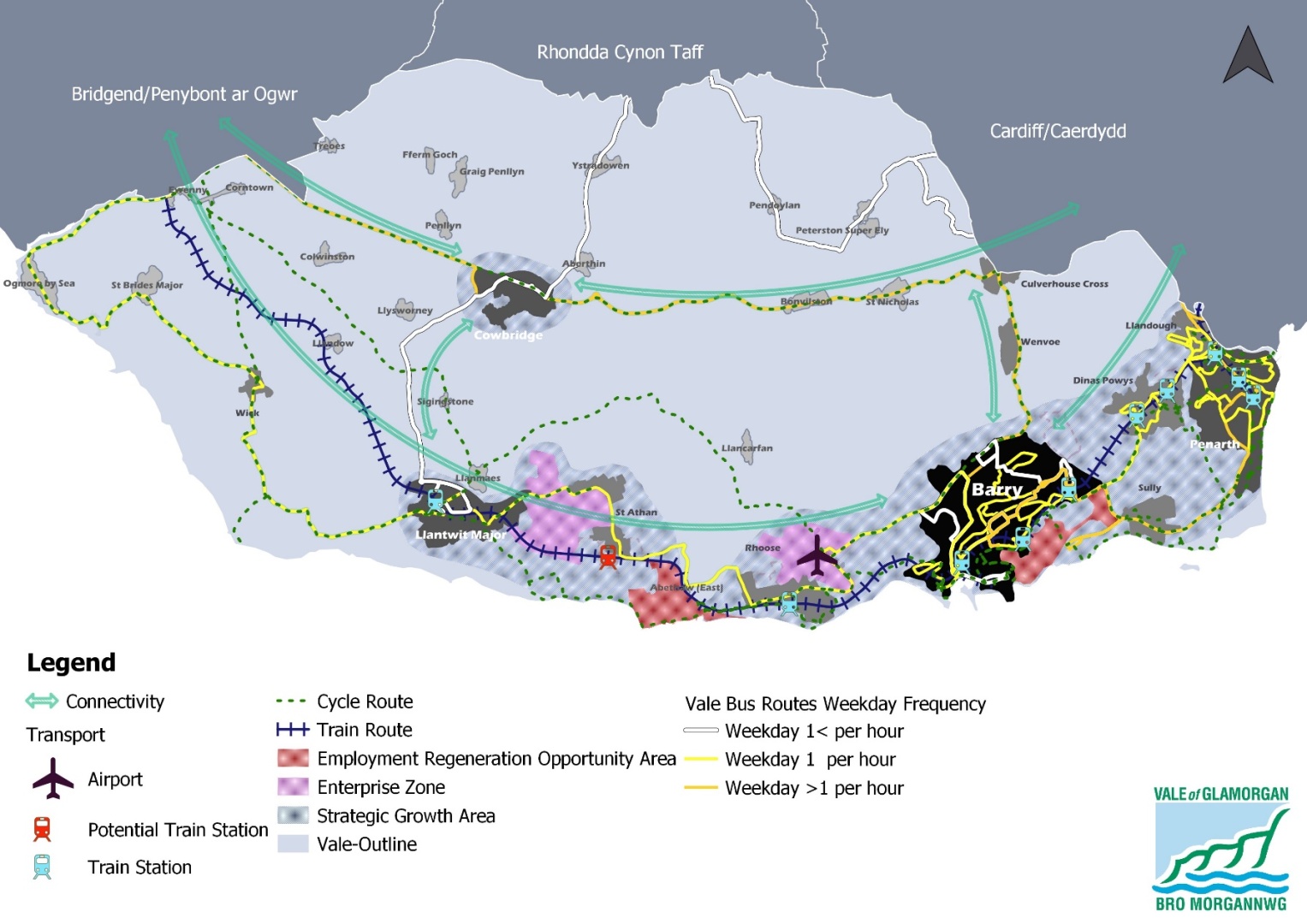
- Focusing development at locations that are well served by existing and proposed rail stations as part of the South Wales Metro and in areas with good bus links. View representations
5.17 While reducing the need to travel is a key policy objective of the RLDP, it is recognised that people will need to travel for work, services and leisure. In line with the transport hierarchy, the RLDP spatial strategy seeks to locate development in places that are well served by sustainable transport.
5.18 The Vale of Glamorgan rail line crosses the southern part of the Vale, linking Cardiff and Bridgend to the settlements of Penarth and Cogan, Dinas Powys, Barry, Rhoose and Llantwit Major. There are currently four rail services an hour between Barry and Cardiff and an hourly service between Barry and Bridgend. There is also a branch line to Penarth, which is also served by four trains to Cardiff. Targeting new development to the settlements that are served by the rail network is a key part of the strategy, as it will facilitate journeys being made by means other than private vehicle.
5.19 To help inform the site selection process, TfW have produced travel time isochrone maps, which identify walking and cycling distances at 5-minute intervals up to 20 minutes from each of the existing rail stations in the Vale of Glamorgan.
5.20 A feasibility study for a new station at St Athan was completed in 2022, which identified four potential site locations for a new station to the south of St Athan. The quantum of development proposed in the wider St Athan area, including two residential led key sites and other housing allocations, the Bro Tathan Enterprise Zone and the proposed Aberthaw Green Energy Park would support the levels of trip generation necessary to support the business case for a station and the Council is actively working with key stakeholders to secure a commitment for a new station in this location.
5.21 In January 2025, the Cardiff Capital Region published the Draft Regional Transport Plan for South East Wales, stating its commitment to investigate opportunities for additional rail infrastructure and freight and passenger services at Aberthaw / St. Athan. The introduction of rail services at St Athan aligns with the regional objectives for establishing a network that achieves a modal shift towards more sustainable forms of transport for both passengers and freight.
5.22 As identified within the Settlements Appraisal Review, Cowbridge is also a sustainable location serving the wider area with a thriving high street accommodating a supermarket and a range of other shops, services and facilities which cater for everyday needs, reducing the need to travel. It also has primary and secondary schools, a leisure centre and health facilities. Whilst not on a rail line, it does have a good bus link to other settlements in the Vale, as well as Cardiff and Bridgend.
- Allowing for small scale affordable housing led development in settlements outside the Strategic Growth Area at a scale proportionate to the size of settlement. View representations
5.23 The Local Housing Market Assessment (LHMA) 2023 identifies a need for 1,075 affordable homes per annum over the next 5 years based on the principal projections or 1,114 based on the RLDP projections. There is an identified backlog of need across all sub-market areas in the Vale of Glamorgan, and the issue is acute in many communities.
5.24 In the rural Vale, development opportunities are limited which can impact on the ability for younger and working aged people to stay within their local communities. A lack of affordable housing is a key factor in existing residents leaving their local communities and restricting the ability of those that may have left the area to return. Retaining younger and working aged people within settlements is important as it allowing those who as it will help maintain a balanced demographic structure and will assist in sustaining local services and facilities, including schools.
5.25 Therefore, a key part of the strategy is to allow for affordable housing led developments within sustainable primary and minor rural settlements outside of the Strategic Growth Area, at a scale that is appropriate to the size of the community it is serving. An ‘affordable housing led’ scheme is one where a minimum of 50% of the dwellings would need to be affordable, although this could increase to a maximum of 100% if the site is brought forward by a social landlord.
- Supporting the role of Cardiff Airport as a strategic gateway for international connectivity. View representations
5.26 Future Wales recognises Cardiff Airport as “an essential part of Wales’s strategic transport infrastructure. It is an international gateway connecting Wales to the world and is an important driver within the Welsh economy.”
5.27 The airport is located within the Cardiff Airport and Bro Tathan Enterprise Zone. The Enterprise Zone is split over two sites – the Cardiff Airport and Gateway Development Zone, which is directly adjacent to the airport, and the Bro Tathan site at St Athan. These strategically located flagship sites are intended to stimulate inward investment and consolidate the role of the Vale of Glamorgan within the Cardiff Capital Region.
5.28 The Cardiff Airport and Gateway Development Zone comprises two distinct areas – Airport Business Park, to the north of Port Road, and the strategic employment site to the south of Port Road, known as Model Farm. The northern site is currently home to the International Centre for Aerospace Training (ICAT), which is part of Cardiff and Vale College (CAVC). CAVC has planning permission for an additional college campus on the part of the site, and a Masterplan is being prepared to assist in the delivery of the remaining land. The Employment Land Study (ELS) indicates that 61.05 Ha of land remains available across the northern and southern parts of this part of the Enterprise Zone. An appeal for non-determination has been submitted to Planning and Environment Decisions Wales (PEDW) for an outline planning application for a B1, B2, B8 Business Park on the southern site (Model Farm). The ELS recommends that this site should be retained for employment use and the site has been rolled forward into the Deposit Plan on this basis. However, consideration will need to be given to the outcome of the planning appeal when a decision has been made by PEDW.
5.29 Bro Tathan has been subject to significant investment to date, including the recent completion of the Northern Access Road, which provides a direct access to the Enterprise Zone. The site also benefits from a civilian operated fully operational 1,800m runway. Several high-profile businesses including Aston Martin Lagonda and eCube Solutions are located on the site. A range of development opportunities remain on the Bro Tathan site for a mix of uses including B1, B2 and B8, as well as an opportunity for a hotel. It is identified that there is 66.7 Ha of net developable land that is realistically likely to be delivered within the plan period, although there is significant additional land available that will be safeguarded.
5.30 It is recognised that there is a tension between the RLDP’s climate change objective and the intention to support Cardiff Airport, given that aviation emissions are a significant global contributor to climate change. This challenge is also recognised in Llwybr Newydd – the Wales Transport Strategy. However, the availability of a local airport does allow South Wales based passengers the opportunity to fly from closer to home, reducing journeys for those that may have otherwise been made to airports outside of Wales. The Welsh Government is working with the UK Government through the Jet Zero initiative to reduce the environmental impacts of aviation.
- Allowing for regeneration opportunities on previously developed and underutilised land, including at the former Aberthaw Power Station and Barry Docks. View representations
5.31 The Sustainable Growth Strategy safeguards land at the former Aberthaw Power Station as a Green Energy Park. A Masterplan is currently being prepared for the site but potential after uses following the demolition of the power station and remediation may include:
- The production of renewable and green energy projects and related employment uses.
- An accompanying battery storage facility to support the green energy projects.
- A zero-carbon manufacturing cluster which will include green hydrogen production facilities.
- A green energy innovation centre to promote innovation, growth, knowledge and community interaction with the zero-carbon future of Wales.
- Development and maintenance of a bio-diverse ecology park which will include a visitor centre, providing amenities to the local community.
- Support for industrial de-carbonisation and long-term energy storage.
5.32 The regeneration of the former power station site at Aberthaw offers a unique opportunity to create highly skilled jobs, whilst making a significant contribution toward mitigating climate change, in accordance with the objectives of the Plan. This significant regeneration opportunity is supported through the RLDP policy framework, informed by the Masterplan that is currently being prepared.
Barry Docks
5.33 The strategy for the adopted LDP primarily focused on the regeneration of previously developed land at the former No. 1 Dock in Barry as a mixed-use strategic site, known locally as Barry Waterfront. The residential part of the development has been largely completed, as have other uses including a new primary school, a superstore and a district centre. Planning permission has also been granted for a new Cardiff and Vale College campus on remaining land at Hood Road.
5.34 Future plans for the continued regeneration of the Waterfront include the redevelopment of the Mole for apartments, a linear park and water sports centre.
5.35 In addition, the Associated British Ports (ABP) have prepared a Masterplan which identifies future redevelopment opportunities on land within their ownership. This includes:
- Upgrading Lady Windsor Lock and installation of new lock gates to meet the needs of all vessels using the Dock.
- Redevelopment of Black Rocks Growth Zone for uses such as battery supply chain, advanced manufacturing, rare earth mineral processing, and next generation biofuel manufacturing.
- The Port Clean Growth Hub focusing on zero carbon manufacturing.
Strategic Growth Area View representations
5.36 The Sustainable Growth Strategy seeks to promote development in the Strategic Growth Area, an area that accommodates the main centres of population and urban settlements that are served by a range of facilities and services and are accessible by a range of transport modes. Within the Strategic Growth Area, Barry is identified as the only Key Settlement. The settlements of Llantwit Major, Penarth and Cowbridge are defined as Service Centres, providing opportunities for sustainable growth. The Primary Settlements of Sully, Dinas Powys, Llandough (Penarth), Rhoose and St Athan have also been included within the Strategic Growth Area, as sustainable locations where new residential development can be aligned with other uses and where there are current and proposed sustainable transport options to reduce the need to travel by car.
Key Diagram View representations
5.37 The Key Diagram at Figure 10 illustrates the RLDP Strategy and shows the extent of the Vale of Glamorgan Council and the RLDP area. The Key Diagram also shows the Strategic Growth Area, strategic transport routes, key locations for future development, the plan’s hierarchy of settlements and interrelationships with adjoining local authorities.