

1 Vale of Glamorgan Deposit Replacement Local Development Plan
2.1 In developing the RLDP, the Council is required to have regard to any relevant national, regional, and local policies and strategies, stakeholder engagement and the findings of the technical background evidence developed to support the plan. Key elements of the context within which the Deposit Plan has been prepared are set out below.
National Policy and Legislation View representations
2.2 The documents considered in this section are national documents that apply across the whole of Wales.
Well-being of Future Generations Act (Wales) 2015 (Well-Being Act)
2.3 The Well-being Act sets the framework for improving the well-being of Wales by ensuring that sustainable development is at the heart of government and public bodies. It aims to make a positive difference to the lives of people in Wales in relation to seven well-being goals:
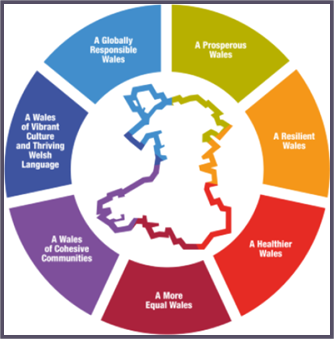
Source: Planning Policy Wales Edition 12 (February 2024)
2.4 The Well-being Act sets out a 'sustainable development principle' and places a well-being duty on public bodies, including local authorities, to 'act in a manner which seeks to ensure that the needs of the present are met without compromising the ability of future generations to meet their own needs'. Sustainable development is at the heart of the RLDP and is a fundamental part of the Integrated Sustainability Appraisal (ISA) process.
2.5 The Well-being Act also requires all public bodies to apply the sustainable development principle in decision making through the adoption of 5 ways of working. These are:
- Taking account of the long term.
- Helping to prevent problems occurring or getting worse.
- Taking an integrated approach.
- Taking a collaborative approach; and
- Considering and involving people of all ages and diversity.
2.6 The five ways of working have been central to the preparation of each of the stages of the RLDP.
Planning (Wales) Act 2015
2.7 The Planning (Wales) Act (Planning Act) came into force in July 2015. It sets out a series of legislative changes to deliver reform of the planning system in Wales, to ensure that it is fair, resilient and enables development.
2.8 The Planning Act also provides the legal framework for the preparation of a National Development Framework (NDF) and Strategic Development Plans (SDPs). Future Wales - the National Plan 2040, the NDF, was published by the Welsh Government in 2021, and is discussed in detail in the next section. SDPs are intended to provide a regional spatial framework for the future development and use of land within a defined region. The South-East Wales Corporate Joint Committee (SEWCJC) is responsible for the preparation of an SDP for the South East Wales region. The Delivery Agreement for the SDP was approved by Welsh Government in August 2025 and plan preparation has commenced. It is anticipated that the SDP will be adopted in late 2031/early 2032. The preparation of the RLDP is therefore progressing ahead of the preparation of the SDP and a review of the RLDP will be required once the SDP is adopted.
Environment (Wales) Act 2016
2.9 The Environment (Wales) Act (Environment Act) aims to improve the management of the natural resources of Wales in a more proactive, sustainable and joined up way. It includes an enhanced biodiversity duty which requires public authorities to maintain and enhance biodiversity and to promote the resilience of ecosystems.
2.10 The Environment Act also introduced a requirement for Natural Resources Wales (NRW) to produce Area Statements. The Vale of Glamorgan is covered by the South-Central Area Statement, which also includes Bridgend, Merthyr Tydfil, Rhondda Cynon Taff, and Cardiff.
2.11 The purpose of Area Statements is to provide the framework for the sustainable management of natural resources. The South-Central Area Statement is guided by the following 5 themes:
- Building resilient ecosystems
- Connecting people with nature
- Working with water
- Improving our health
- Improving our air quality
Active Travel (Wales) Act 2013
2.12 The Active Travel (Wales) Act (Active Travel Act) aims to promote walking and cycling as a means of transport for short journeys (i.e., to access work, school or shops and services). The Active Travel Act places a legal duty upon local authorities to plan suitable routes for active travel, produce active travel maps, consider the needs of pedestrians and cyclists and to deliver improvements in active travel routes and facilities.
2.13 To achieve these objectives, the Active Travel Act requires local authorities to identify active travel routes and related facilities through the development of Active Travel Network Maps (ATNM). The ATNM for the Vale of Glamorgan forms part of the evidence base for the RLDP.
A More Equal Wales - The Socio-economic Duty (2021)
2.14 The Socio-economic Duty is a legal requirement under the Equality Act 2010 that came into force in Wales on the 31 March 2021. The Socio-economic Duty requires specified public bodies to consider how their decisions can help to reduce the inequalities associated with socio-economic disadvantages when making strategic decisions.
2.15 The Duty requires that public bodies consider the need to reduce the inequalities of outcomes resulting from socio- economic disadvantage. This includes considering how policies, programmes and services can reduce inequalities and promote social inclusion. As the Duty applies to strategic policy development, it is relevant to the RLDP. The Socio-economic Duty falls within the scope of the ISA undertaken in respect of the RLDP and the findings of the appraisal are set out in the ISA documents.
Public Health (Wales) Act 2017
2.16 Part 6 of The Public Health (Wales) Act places a requirement for public bodies to conduct Health Impact Assessments (HIAs) in specific circumstances. The draft regulations set out the circumstances in which a public body must conduct a HIA; and the way in which a HIA is to be carried out.
2.17 The purpose of HIA is to ensure that the effects of development on both health and health inequalities are considered and addressed during the planning process, and this should be undertaken at an early stage in the development plan so that any relevant health impacts are identified and addressed. In preparing the RLDP, the ISA incorporates HIA into the appraisal methodology and includes specific health and well-being measures.
Future Wales - The National Plan 2040 (Welsh Government, February 2021)
2.18 Future Wales – the National Plan 2040is Wales’ national development framework, setting the direction for development in Wales to 2040. It is a development plan with a strategy for addressing key national priorities through the planning system, including sustaining and developing a vibrant economy, achieving decarbonisation and climate‑resilience, developing strong ecosystems and improving the health and well‑being of our communities. It is the highest tier of development plan in Wales and is focused on solutions to issues and challenges on a national scale. Future Wales sets out where nationally important growth and infrastructure is needed and how the planning system at a national, regional and local level can deliver it. It provides direction for SDPs and LDPs and supports the determination of Developments of National Significance.
2.19 Future Wales sets out 11 outcomes which collectively are a statement of where the Welsh Government wants Wales to be by 2040. The outcomes are:
A Wales where people live….
- and work in connected, inclusive and healthy places.
- in vibrant rural places with access to homes, jobs and services.
- in distinctive regions that tackle health and socio-economic inequality through sustainable growth.
- in places with a thriving Welsh Language.
- and work in towns and cities which are a focus and springboard for sustainable growth.
- in places where prosperity, innovation and culture are promoted.
- in places where travel is sustainable.
- in places with world-class digital infrastructure.
- in places that sustainably manage their natural resources and reduce pollution.
- in places with biodiverse, resilient and connected ecosystems.
- in places which are decarbonised and climate resilient.
2.20 Future Wales sets out 18 national policies that apply across the whole of Wales, and 4 regional policies that apply across the South-East Region. Whilst all the policies will need to be addressed in the RLDP, the following policies have particular importance for the plan’s strategy:
- Policy 1 - Where Wales will Grow - Policy 1 of Future Wales identifies three National Growth Areas, including South East Wales. The spatial strategy diagram supporting this policy identifies that the Vale of Glamorgan is located within the South East National Growth Area, referred to as ‘Cardiff, Newport, and the Valleys.’ Policy 1 is supplemented by Policy 33, which specifically relates to the Cardiff, Newport, and the Valleys National Growth Areas.
- Policy 2 - Shaping Urban Growth and Regeneration - Strategic Placemaking sets out the key placemaking principles that should be considered when determining the location of new development. This includes creating a mix of uses and variety of house types and tenures, building places at a walkable scale with homes, local facilities, and public transport within walking distance and ensuring development is built at appropriate densities with green infrastructure incorporated.
- Policy 6 - Town Centre First sets out a town centre first approach to the delivery of significant new commercial, retail, education, health, leisure, and public service facilities which must be located within town and city centres. The supporting text for the policy also indicates that town centres are appropriate locations for new homes.
- Policy 7- Delivering Affordable Homes re-affirms Welsh Government's aspiration to deliver significant levels of affordable housing, including through the planning system.
- Policy 8 – Flooding supports flood risk management that facilitates sustainable economic and national growth, promoting nature-based solutions and seeking to maximise social, economic and environmental benefits from flood risk management infrastructure.
- Policy 9 - Ecological Networks and Green Infrastructure - Policy 9 requires action toward safeguarding and creating resilient ecological networks and promoting effective green infrastructure through placemaking. It prescribes that existing and potential areas should be included in Development Plans to promote and safeguard the functions and opportunities that ecological networks and green infrastructure provide.
- Policy 10 - International Connectivity - A Strategic Gateway being identified at Cardiff Airport to facilitate international connectivity. The LDP will need to support the Strategic Gateway by maximising the benefits they provide to their respective regions and Wales. New development around the Strategic Gateways should be carefully managed to ensure their operation is not constrained or compromised.
- Policy 12 - Regional Connectivity - sets out that LPAs must maximise opportunities arising from the investment in public transport when planning for growth and regeneration. Planning authorities must integrate site allocations, new development, and infrastructure with active travel networks and, where appropriate, ensure new development contributes towards their expansion and improvement. The Welsh Government's commitment to improving and increasing sustainable transport requires authorities in the national growth area to plan for growth to maximise opportunities arising from investment in public transport.
- Policy 15 – National Forest - The Welsh Government is committed to developing a national forest through the identification of appropriate sites and mechanisms, with a target to increase woodland cover across Wales by at least 2,000 hectares per annum. The national forest will comprise of three strands:
- Quality environment which comprises connected ecosystems, biodiversity and habitats, restoration of undermanaged woodland and ancient woodland;
- Productive woodland; and
- Community woodland.
- Policy 16 - Heat Networks - Barry is specifically identified as a location for the consideration of a district heat network.
- Policy 33 - National Growth Area – Cardiff, Newport and the Valleys - The regional spatial diagram for South-East Wales (Figure 2 below) highlights that Cardiff, Newport, and the Valleys, including the Vale of Glamorgan, are part of a national growth area. Strategic and Local Development Plans should recognise the National Growth Area (NGA) as the focus for strategic economic and housing growth, services and facilities; advanced manufacturing; transport and digital infrastructure. To deliver these regional priorities and aspirations, Future Wales recognises that the 10 local authorities within the region do not exist in isolation from each other and that in preparing Local Development Plans, planning authorities “will need to consider the interdependence of Cardiff and the wider region, ensuring communities around the Capital are vibrant, prosperous and connected”. For the Vale of Glamorgan RLDP this will require the plan to consider how its aspirations for housing and economic growth align with and complement the wider regional aspirations, particularly those of neighbouring Cardiff.
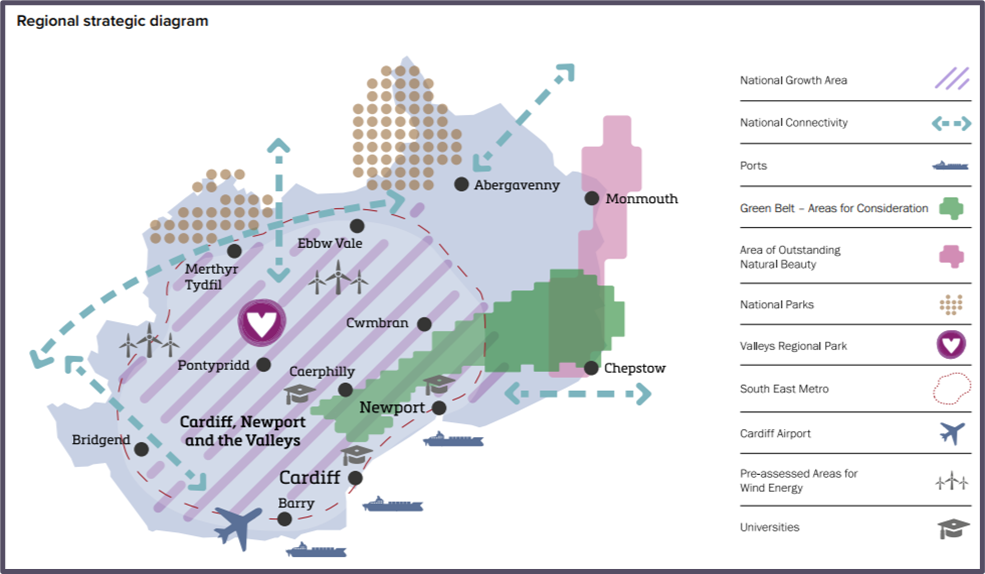
Source: Future Wales - the National Plan 2040
2.21 Policy 36 – South East Metro - provides a regional policy basis for the development of the Metro and for Metro focused developments. Planning authorities should plan growth and regeneration to maximise the opportunities arising from better regional connectivity, including identifying opportunities for higher density, mixed‑use and car‑free development around new and improved metro stations.
Wales National Marine Plan (2019)
2.22 The Wales National Marine Plan (WNMP) sets out the Welsh Government policy for the next 20 years for the sustainable use of the seas. The plan contains plans and policies which will support the vision for clean, healthy, safe and diverse seas, guide future sustainable development and support the growth of marine space and natural resources (’blue growth’).
2.23 The Plan sets out policies under the categories of:
- Achieving a sustainable marine economy (sustainable economic growth, coexistence).
- Ensuring a strong, health and just society (including access to the marine environment, well-being of coastal communities, landscapes and seascapes, coastal flooding and climate change).
- Living within environmental limits (resilient marine ecosystems, air and water quality).
- Promoting good governance (cumulative effects, cross border and plan compatibility).
- Using sound science responsibly.
2.24 The WNMP sector specific supporting policies operate alongside the general policies and set policy for the future development and use of the marine plan area by certain sectors. This includes uses such as inshore and offshore aggregates, aquaculture, dredging, marine renewable energy, ports and shipping, and tourism and recreation.
Planning Policy Wales Edition 12 (2024)
2.25 Planning Policy Wales (Edition 12) (PPW) sets out the land use planning policies and overarching sustainable development goals for Wales, revised to contribute towards the statutory well-being goals of the Well-being of Future Generations Act 2015. PPW sets out a presumption in favour of sustainable development and considers a Plan-led approach to be the most effective means of securing sustainable development through the planning system.
2.26 PPW has a strong focus on promoting placemaking, which is considered instrumental to achieving sustainable places, delivering socially inclusive development and promoting more cohesive communities. Placemaking is deemed to be a holistic approach that 'considers the context, function and relationships between a development site and its wider surroundings'.
2.27 At a strategic level there are four themes which contribute individually to placemaking:
- Strategic & Spatial Choices;
- Active & Social Places;
- Productive & Enterprising Places;
- Distinctive & Natural Places
2.28 PPW requires development plans to “include a spatial strategy covering the lifetime of the plan which establishes a pattern of development improving social, economic, environmental and cultural well-being,” and that “a broad balance between housing, community facilities, services and employment opportunities should be promoted.”
Technical Advice Notes (TANs), Minerals Technical Advice Notes (MTANs), Circulars and Policy Clarification Letters
2.29 The RLDP will consider the requirements set out within the series of TANs, MTANs, Circulars and Policy Clarification Letters, which expand on a range of planning policy issues.
Building Better Places - The Planning System Delivering Resilient and Brighter Futures: Placemaking and the Covid-19 recovery (WG, July 2020)
2.30 Building Better Places sets out the Welsh Government's planning policy priorities to assist in the recovery period after the Covid-19 pandemic crisis. It recognises that the planning system should be central to the consideration of built and natural environment issues that have arisen from the pandemic. The document highlights the key existing planning policies and tools which should be used by all sectors in the environmental, social, cultural and economic recovery of Wales. LDPs should actively embrace the placemaking agenda set out in PPW, identifying its character, strengths and areas which need improving and set out policies on how these areas will be improved.
2.31 The document reinforces the Welsh Government's commitment to better places, placemaking, quality outcomes and good design and identifies policy areas that should be the focus of consideration and action, to function as a catalyst for recovery. It identifies key issues which bring individual policy areas together to ensure that action is the most effective. The RLDP is a key tool for addressing these issues and will play a vital role in supporting the post-covid recovery in the Vale of Glamorgan whilst also contributing towards the future resilience of communities.
2.32 The 8 issues are:
- Staying local: creating neighbourhoods.
- Active travel: exercise and rediscovered transport methods.
- Revitalising our town centres.
- Digital places: the lockdown lifeline.
- Changing working practices: our future need for employment land.
- Reawakening Wales' tourism and cultural sectors.
- Green infrastructure, health and well-being and ecological resilience.
- Improving air quality and soundscapes for better health and well-being.
Llwybr Newydd: The Welsh Transport Strategy (2021)
2.33 The Welsh Government’s Transport Strategy sets out three priorities for the next 5 years:
- Bring services to people in order to reduce the need to travel.
- Allow people and goods to move easily from door to door by accessible, sustainable, and efficient transport services and infrastructure.
- Encourage people to make the change to more sustainable transport.
2.34 The Strategy sets out a sustainable transport hierarchy to inform decisions about new infrastructure.
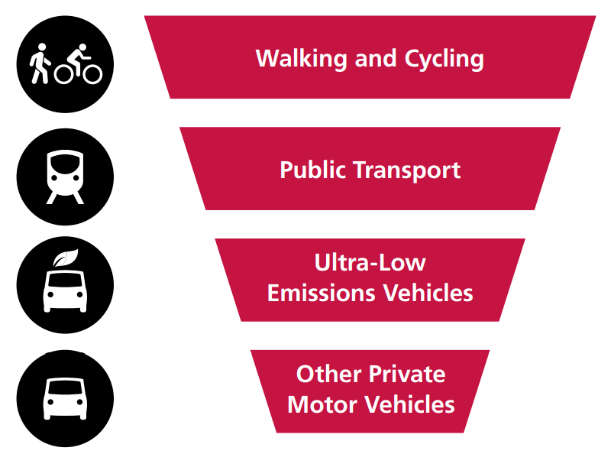
Source: Llwybr Newydd
Welsh Government’s Climate and Nature Emergency Declarations
2.35 In response to growing evidence on the impacts of climate change, the Welsh Government declared a ‘climate emergency’ in April 2019. The announcement was made to draw attention to the magnitude and significance of the evidence continually being presented by the Intergovernmental Panel on Climate Change. The declaration was made to send a clear signal that the Welsh Government will not allow the process of leaving the European Union to detract from the challenge of climate change.
2.36 A further declaration was made in June 2021, as the Welsh Government declared a nature emergency to ensure parity between actions taken by the Welsh Government to tackle climate change and biodiversity loss. The purpose of this was to set targets for limiting biodiversity loss, similar to those that exist for carbon emissions.
2.37 This is reiterated at the international level, with the UN Biodiversity Conference (COP15) reaching agreement from nearly 200 countries around the world to meet a target of ’30 x 30’ – an ambition target to conserve 30% of the world’s land and 30% of the ocean by 2030.
Regional Context View representations
Cardiff Capital Region City Deal
2.38 The Cardiff Capital Region (CCR) comprises ten local authorities across the South-East Wales region, including the Vale of Glamorgan working collaboratively on projects and plans aimed at building on the region’s sectoral strengths. These strengths include the region’s high skill base, and three successful universities and projects will seek to accelerate economic growth and productivity through a series of considered targeted investments in skills, infrastructure, innovation-led scalable projects and in priority industry sectors and businesses. The CCR City Deal will help boost economic growth by improving transport links, increasing skills, helping people into work and giving businesses the support they need to grow. CCR has funded several major investments within the region, including the recent purchase of the former Aberthaw Power Station to facilitate its demolition, remediation and redevelopment as a Green Energy Park.
CCR Regional Economic and Industrial Plan 2023-2028
2.39 Cardiff Capital Region (CCR) Regional Economic and Industrial Plan has been prepared to foster a regional economy that is bigger, fairer and greener, generating good growth and creating conditions for shared prosperity across the ten local authorities in the region. The Plan identifies a number of challenges but seeks to achieve the ambition of being “a proud Cardiff Capital Region where everyone is connected locally and globally, enjoying work, business and life opportunities that make us the place to fulfil potential.”
2.40 The Plan identifies three areas of focus – Becoming More Competitive, Becoming More Connected and Becoming More Resilient. As part of the Becoming More Competitive theme, specific reference is given to growing the green economy through innovation initiatives centred on green technologies and future skills, with specific reference to the development of a Green Energy Park at Aberthaw. The RLDP will have a role in facilitating land and developing appropriate policies that would support the objectives and projects within the Plan.
South Wales Metro
2.41 The South Wales Metro was part of the original CCR City Deal, with over half of the City Deal total funding being ring-fenced for Metro development. Welsh Government, through Transport for Wales (TfW), operates the metro rail services within the region, whilst local authorities are responsible for bus services and active travel. The Metro is an ambitious project aimed at providing an integrated network of active, bus and rail travel that will improve accessibility and make sustainable transport across and throughout the region easier and faster.
2.42 Furthermore, Metro Plus funding for schemes that support the implementation of the South Wales Metro is also available, with the Vale having benefitted from funding for the development of a new transport interchange at Barry Docks.
2.43 Future Wales sets out the requirement for LDPs to plan for growth that will maximise the benefits of the Metro funding.
South East Wales Regional Transport Plan (Draft 2025)
2.44 The Cardiff Capital Region (CCR) Draft Regional Transport Plan (RTP), also known as "Transport for CCR," is a long-term vision for developing an efficient, sustainable, and inclusive transport network across South East Wales. The RTP aims to guide transport investment and policy from 2025 to 2030 and beyond.
2.45 The core aims of the RTP are to build a Competitive, Connected, and Resilient Region by establishing an efficient, affordable, and low-carbon transport network that:
- Enhances quality of life: This includes improving access to jobs, education, healthcare, and leisure activities for all communities.
- Fosters shared prosperity: By linking businesses, stimulating economic growth, and creating job opportunities across the region.
- Supports a carbon-neutral region: Prioritising walking, cycling, and "wheeling" for shorter journeys, and accelerating the decarbonisation of the vehicle fleet.
- Improves accessibility for all: Ensuring equitable access to transport regardless of circumstances, including for those with reduced mobility.
- Reduces emissions: Targeting a 60% reduction in greenhouse gas, air pollution, and noise emissions from road transport by 2035.
- Maximises digital and physical infrastructure: Making better use of existing transport infrastructure and integrating digital solutions.
- Promotes behavioural change: Increasing understanding of sustainable transport options and encouraging shifts away from single-occupancy car use.
- Improves safety and security: Reducing road traffic casualties and enhancing perceived safety when traveling.
- Strengthens links: Connecting communities and improving transport connections within South East Wales, the rest of the UK, and beyond.
2.46 The RTP aligns with the Welsh Government's ‘Llwybr Newydd: The Wales Transport Strategy 2021’ and moves away from individual local transport plans towards a more integrated regional approach, with Corporate Joint Committees taking the lead. While the plan covers strategic road and rail networks, it focuses on schemes to be delivered by local authorities.
2.47 It is recognised that the Vale of Glamorgan faces a range of transport challenges. These include an ageing population placing increased pressure on public transport, disparities in transport access between coastal communities and inland areas, more limited public transport options in rural areas, and peak-time congestion on major routes. The Draft RTP highlights that the Vale of Glamorgan to Cardiff represents the highest number of daily road trips, with a weekday AM peak of 7,358 vehicles recorded, and 5,385 trips from Cardiff to the Vale of Glamorgan.
2.48 Future transport proposals for the Vale of Glamorgan will be shaped by the objectives of the Draft RTP. Many objectives are relevant across the region, but specific objectives and strategic activities where the Vale of Glamorgan is specifically referenced include:
- Support the Region’s ambition to expand the rail network, including taking opportunities to build on existing planned programmes such as Cardiff Cross Rail, to further develop options that include greater frequencies on the City Line, expansion to Cogan and further afield.
- Investigate opportunities for additional rail infrastructure and freight and passenger services at Aberthaw / St. Athan to maximise the connectivity between road, rail, air and maritime networks
- Deliver a lower carbon, accessible, integrated, and reliable transport network, for both staff and passengers to access the airport, which also facilitates sustainable access to the neighbouring Bro Tathan Business Park.
- Maximise the airport’s transport role as a national and international transport interchange and gateway into Wales for business and leisure travellers.
- Working with Associated British Ports, Cardiff, Newport and Vale of Glamorgan councils and local bus operators to improve access to the Region’s ports, to help sustain their status as strategic employment sites.
2.49 The RTP is supported by a Regional Transport Delivery Plan (RTDP), which identifies schemes and interventions that local authorities intend to progress to achieve the vision and objectives of the RTP and the Llwybr Newydd priorities. Specific reference is given in the Draft RTDP to active travel proposals between Barry and Cosmeston, Barry and Dinas Powys and Barry and Cardiff Airport, as well as opportunities at Cogan station.
Regional Technical Statement for Aggregates (2020) Second Review
2.50 The South Wales Regional Aggregates Working Party (SWRAWP) has produced the Regional Technical Statement (RTS). The second review (referred to as RTS2), was published in 2020. Minerals TAN 1 (paragraph 1.45 refers) sets an overarching objective, which seeks to ensure a sustainably managed supply of aggregates essential for construction by striking the balance between environmental, economic and social costs. The RTS has been formulated to help guide individual Local Authorities in South Wales on how to implement these mineral planning policies in the formulation of their individual LDP policies and allocations.
Cardiff and Vale Regional Partnership Board Joint Area Plan for 2023 to 2028
2.51 The Joint Area Plan is a key document prepared jointly by the Vale of Glamorgan Council, Cardiff Council, Cardiff and Vale University Health Board, Welsh Ambulance Service NHS Trust, housing, Third & Independent sectors and carer representatives. It sits alongside the Wellbeing Plans from the respective areas to provide a whole system approach to improving the health and wellbeing of the population of Cardiff and the Vale of Glamorgan. It identifies priorities around three life stages:
- Starting Well: giving every child the best start in life.
- Living Well: supporting people to live well and do the things that matter to them.
- Ageing Well: enabling people to stay independent as they become older.
Regional Collaboration
2.52 The Vale of Glamorgan does not exist in isolation to other local authorities and interacts with nearby local authorities regionally on strategic matters including LDP preparation. The Vale of Glamorgan is a member of the South-East Wales Strategic Planning Group (SEWSPG) consisting of the 10 local authorities of the CCR to consider policy issues that affected the region.
2.53 To date the Vale of Glamorgan Council has collaborated with other authorities in respect of joint development of evidence for RLDPs and will continue to work collaboratively on a number of ongoing projects. The completed and ongoing projects include:
- Agreement of a common methodology on Sustainable Settlement Appraisals.
- Procurement of a consultation database system for the LDP (Caerphilly, Vale of Glamorgan and Rhondda Cynon Taf).
- Employment Land Survey methodology.
- Regional Strategic Flood Consequences Assessment.
- The development of a development viability model for site-specific and high-level viability assessments (all 10 CCR authorities and local authorities in the Mid and West Wales Regions).
- Green Belt and Green Wedge Identification Regional Methodology.
- Common methodology for the determination of affordable housing transfer values.
- Strategic Transport Assessment utilising South East Wales Regional Transport Model.
2.54 Collaboration and liaison with the other local authorities regionally will continue as the RLDP progresses including joint commissioning or collaboration where appropriate.
Local Development Plans and Neighbouring Local Planning Authorities
2.55 The Vale of Glamorgan’s neighbouring local authorities are Bridgend County Borough Council to the west, Cardiff Council to the east and Rhondda Cynon Taf (RCT) County Borough Council to the north.
2.56 As prescribed in the Planning and Compulsory Purchase Act 2004 and set out in national planning policy, an LDP must be sound. Part of the process of establishing soundness is to consider the plan against tests of soundness. Test of soundness 1 ‘Does the plan fit?’ requires the Council to demonstrate that it is consistent with the plans of neighbouring authorities.
2.57 Bridgend’s RLDP was adopted in March 2024. The Vale and Bridgend have been in close collaboration on cross-boundary issues throughout the preparation of the Bridgend RDLP, culminating in an agreed ‘Statement of Common Ground’, stating that the Vale did not raise any concerns or objections through the formal consultation process regarding the RLDP and its supporting evidence base.
2.58 The Vale of Glamorgan and neighbouring Cardiff have similar timescales for the preparation of their RLDPs, consequently planning officers from both authorities hold regular informal meetings to discuss each authority’s emerging plans, particularly in respect of cross boundary matters such as housing, employment and transport. Cardiff Council published its Deposit RDLP for consultation in February 2025. A joint position statement on the relationship between Cardiff and the Vale of Glamorgan RLDPs has been prepared which explains the relationship between the two adjoining authorities and how both plans are considered to complement rather than compete which each other. The Council have also held discussions with RCT who published their Preferred Strategy in February 2024, and the Council continues to engage with its neighbours on any cross-boundary issues emerging from these development plans.
2.59 In addition, a regional assessment of future growth and migration for the Cardiff Capital Region has been prepared which assessed the proposed population and jobs growth in the respective RLDPs across the South East Wales. This considered the proposed population and jobs growth across the region from a numerical and spatial perspective and how this aligned with Future Wales. The study concluded that there was alignment between forecast higher level jobs growth and the cumulative jobs growth proposed in development plans. A Background Paper has been prepared to set out the Regional Collaboration that has informed plan preparation.
Local Policy Context View representations
2.60 The following section identifies the key Council documents that have informed the development of the Deposit RLDP. Additionally, key evidence prepared by the Council such as that relating to housing need will also be utilised in the development of policies and reference to this evidence base will be referred to within the RLDP.
Declared Climate and Nature Emergencies
2.61 In July 2019, the Vale of Glamorgan Council joined with Welsh Government and other Councils across the UK in declaring a global ‘climate emergency’. The Council made a commitment to:
- Reduce the Council’s carbon emissions to net zero before the Welsh Government target of 2030 and support the implementation of the Welsh Government’s new Low Carbon Delivery Plan.
- Make representations to the Welsh and UK Governments, as appropriate, to provide the necessary powers, resources and technical support to Local Authorities in Wales to help them successfully meet the 2030 target.
- Continue to collaborate with partners across the region.
- Work with local stakeholders including Councillors, residents, young people, businesses, and other relevant parties to develop a strategy in line with a target of net zero emissions by 2030 and explore ways to maximise local benefits of these actions in other sectors such as employment, health, agriculture, transport and the economy.
2.62 Linked to the declaration of a climate emergency, in July 2021 the Vale of Glamorgan Council declared a ‘nature emergency’ and committed to a target of no net loss to biodiversity in the Vale of Glamorgan. The Council is committed to working with local, regional and national partners to continue to develop and implement best practice methods that can protect Wales’ biodiversity.
Vale of Glamorgan Well-Being Plan 2023-28
2.63 As part of the requirements of the Well-being of Future Generations Act the Council, together with public sector partners as the Vale of Glamorgan Public Services Board (PSB), has prepared its 2nd Well-being Plan for the Vale. Informed by a Well-being Assessment, the Well-being Plan encompasses the 7 well-being goals and provides a framework for all public sector bodies to deliver the Sustainable Development Principle through adopting the 5-ways of working.
2.64 The new Well-being Plan sets out three new Well-being Objectives and the priority areas that the PSB will be focusing on, and the objectives reflect the key issues and key challenges identified by the Vale of Glamorgan Well Being Assessment:
- A more resilient and greener Vale - by understanding and making the changes necessary as individuals, communities, and organisations in response to the climate and nature emergencies.
- A more active and healthier Vale – by encouraging and enabling people of all ages to be more active and to promote the benefits of embracing a healthier lifestyle.
- A more equitable and connected Vale - by tackling the inequities that exist across the Vale, engaging with our communities and providing better opportunities and support to make a lasting difference.
2.65 To deliver these objectives, the Well-being Plan has identified 3 priority workstreams within which collaboration will be focused:
- Responding to the climate and nature emergencies - The Well-being Assessment sets out some of the key issues for the Vale in terms of the climate and nature emergencies and partners recognise that the changes needed across our organisations and communities can best be achieved by working together. This will include consideration of transport, energy, food, biodiversity and how we use our buildings and land.
- Working with the people who live in our communities that experience the highest levels of deprivation - The Well-being Assessment has highlighted the differences across the Vale and how these inequalities have been exacerbated by the Covid 19 pandemic. The Well-being Plan will give particular focus on those areas of the Vale of Glamorgan identified as more deprived by the Welsh Index of Multiple deprivation and addressing inequalities in these communities.
- Becoming an Age Friendly Vale - The proportion of the Vale’s population aged between 65-84 is projected to increase. The Well-being Plan will seek to ensure that the Vale is more age friendly and a better place for people to grow old, making it a friendlier place for all and recognising the contribution that older people make.
The Vale of Glamorgan Corporate Plan 2025-2030 (Vale 2030)
2.66 The Vale of Glamorgan Corporate Plan is the Council’s key strategic document and sets out the framework for the various activities the Council undertakes. It seeks to deliver a wide range of outcomes measured against the plan’s 4 well-being objectives:
- Creating Great Places to Live, Work and Visit.
- Respecting and Celebrating the Environment.
- Giving Everyone a Good Start in Life.
- Supporting and Protecting Those Who Need Us.
2.67 For each objective, the plan sets out how the Council will collaborate with the community and partners to deliver the objectives over the 5-year Corporate Plan period. The Corporate Plan specifically references ‘delivering a Replacement Local Development Plan which balances the need for sustainable growth, the nature and climate emergencies, and the social and cultural needs of the Vale of Glamorgan.’
2.68 Furthermore, there are a number of other specific actions relevant to land use planning and the RLDP set out within the Corporate Plan that will help deliver against the well-being objectives, most notably:
- Applying the principles of placemaking across all our activities ensuring a strong emphasis on local need and the voice of the community.
- Delivering a programme of major investment to secure the long-term regeneration of Barry with a strong focus on partnership working and placemaking.
- Supporting the development of the Cardiff Capital Region Energy site (formerly Aberthaw Power Station) and the Bro Tathan and Cardiff Airport Enterprise Zone as key economic growth areas for the Vale of Glamorgan and wider region.
- Increasing the supply of good quality, accessible and affordable housing.
- Making sure there are affordable and accessible ways for people to participate in leisure, play, sport, cultural and heritage activities.
- Creating an environment for businesses to invest and thrive in the Vale.
- Delivering our Project Zero programme to reduce the Council’s carbon emissions to net zero and to take action to achieve net zero across Wales by 2050.
- Developing and implementing new planning policies to support delivery of the 2050 target and reduce emissions associated with new developments and housing.
- Supporting a change in how people travel by increasing opportunities for active travel and promoting the need for quality and timely local public transport services.
- Encouraging the use of ultra-low emission vehicles by installing electric vehicle charging points across the Vale and reviewing the Council’s fleet of vehicles.
- Taking a leading role in the delivery of ‘Towards Zero Waste’ National Waste Strategy and working to keep more of our waste local and limit what goes into the system by reducing, reusing and recycling more.
- Improving our green infrastructure, increasing biodiversity, how we connect with nature and our appreciation and respect for the natural world.
- Protecting our communities, land and buildings from the impact of flooding and coastal erosion.
Age Friendly Vale Strategy and Action Plan 2025-2028
2.69 The Vale of Glamorgan has been awarded Age Friendly Status by the World Health Organisation, recognising the local commitment, progress made to date, and intentions moving forward to continue to support people of all ages to live and age well in the Vale of Glamorgan. To build on the progress of the Vale becoming an age-friendly community, a Strategy and Action Plan has been prepared which sets out a charter of commitments, many of which the land use planning system and the RLDP can contribute towards achieve. These aspirations set out in the Strategy are:
- People have a sense of purpose, feel respected and are actively engaged in their communities.
- People are well informed about the support and opportunities available to them through a range of different types of communication.
- People have access to suitable forms of transport across the Vale.
- People have opportunities to influence decisions that affect all aspects of their life.
- People are supported to access, maintain work, and volunteering opportunities.
- People are supported to stay healthy and independent through access to appropriate services.
- People have access to safe outdoor spaces and buildings with suitable facilities.
- People feel safe and comfortable inside their homes.
Project Zero- The Vale of Glamorgan Council’s Climate Change Challenge Plan 2021-2030
2.70 In February 2020 the Council signed a Climate Emergency Charter with the Vale PSB, setting out the PSB’s shared commitment to lead by example, take positive action and to reduce its impact on climate change.
2.71 Project Zero is the Vale of Glamorgan Council’s response to the climate change emergency. Project Zero brings together the wide range of work and opportunities available to tackle the climate emergency, reduce the Council’s carbon emissions to net zero by 2030, and encourages others to make positive changes. The strategy highlights the role of the adopted LDP in contributing to the climate change commitment through for example securing planning contributions towards sustainable transport schemes and through the implementation of policies that encourage renewable energy.
2.72 The RLDP provides the opportunity for the Council to explore ways to take forward the Council’s climate change commitments to Wales’s transition to a low carbon nation.
The Vale of Glamorgan Local Area Energy Plan (2024)
2.73 The Vale of Glamorgan Local Area Energy Plan (LAEP) has been produced to identify the most effective route for the Vale of Glamorgan to reach a net zero energy system. The pathway set out for achieving net zero cannot be achieved by the Council alone and involves commitments and responsibilities for partner organisations and companies at national, regional and local levels. As set out in the document’s Vision, the LAEP ‘represents our collective commitment to shaping a future where energy is clean, accessible, and equitable for all residents and businesses, and considerate of future generations.’
2.74 To achieve the Vision, the LAEP is accompanied by 12 objectives:
- Maximise reduction in carbon emissions across all activity.
- Improve efficiency to reduce energy demand.
- Strategically seek and leverage a diverse range of financial resources to support initiatives aimed at reducing carbon emissions.
- Support the Vale of Glamorgan Council’s Project Zero aspirations to be net zero by 2030.
- Work towards new and existing buildings becoming low carbon prioritising inclusivity, equality, and fairness.
- Sensitively deploy renewable energy to the greatest extent possible
- Exploit opportunities for green hydrogen implementation for transport and industry.
- Foster resilience in the energy supply chain through energy diversity including community energy projects.
- Improve and increase electrification of the transport system alongside modal shift.
- Nurture partnerships and collaboration between local government, businesses, educational institutions, community organisations, and energy stakeholders.
- Cultivate the supply chain to provide quality jobs and economic opportunities.
- Create the workforce to reach net zero 2050 targets.
2.75 The LAEP is a live document which should be updated every 5 years. It identifies the following priority areas that will be the focus in the short term to assist in setting the Vale on the pathway to net zero:
- Making homes low carbon
- Adopting onshore renewables
- Moving Transport and logistics to net zero
- Supporting industrial energy transition
- Reinforce and transition the gas and electricity distribution networks.
2.76 The LAEP includes stark figures for what must be delivered to achieve net zero by 2050, for example, deploying 1,190 GWh of ground-mounted PV compared to 85 GWh in 2023. The RLDP Plan period encompasses a significant period within which action will need to be taken to achieve net zero. Indeed, the LAEP envisions the late 2020s and early 2030s as being a period where deployment of technologies required to meet net zero accelerates. The RLDP will set out the local planning framework during this period. Therefore, the implications of achieving net zero, as implied by a preferable pathway set out in the LAEP, need to be acknowledged within the RLDP.
The Vale of Glamorgan Local Transport Plan 2015-2030
2.77 The Council’s Local Transport Plan (LTP) seeks to identify the sustainable local transport measures required to ensure the Vale of Glamorgan adheres to requirements set by Welsh Government and current good practice guidance. The LTP sets out several short-term objectives to 2020 and includes medium and longer-term objectives to 2030. The LTP has been informed by proposals within the Council’s adopted LDP and is also consistent with the Wales Transport Strategy objectives.
2.78 In identifying schemes, the LTP seeks ways to secure better conditions for pedestrians, cyclists, and public transport users and to encourage a change in travel choices away from single occupancy vehicles. The LTP also seeks to tackle traffic congestion by securing improvements to the strategic highway corridors for commuters who may need to travel by car as well as providing better infrastructure for freight. It also seeks to address the key road safety priorities for the Vale. The LTP supports proposals for the Cardiff Metro and will inform future regional transport planning work.
The Vale of Glamorgan Biodiversity Forward Plan (2019)
2.79 The Vale of Glamorgan Biodiversity Forward Plan (BFP) focusses on how the Council manages and improves natural resources to ensure that biodiversity and sustainability are considered in all service areas and are core themes in service delivery, becoming an integral part of the decision-making processes throughout the Council. The plan sets out how the Vale of Glamorgan Council shall meet its obligations under section 6 of the Environment (Wales) Act 2016 to demonstrate how the Local Authority will “seek to maintain and enhance biodiversity in the proper exercise of their functions and in doing so promote the resilience of ecosystems”.
2.80 Part one of the Forward Plan sets out the background (including the legislative context), identifies challenges and opportunities and sets out the actions and targets to be undertaken to achieve these aims. The actions in the BFP are reported on every three years in accordance with statutory requirements and reviewed and updated at the end of each 3-year reporting period. The review of the BFP will coincide with that of the LDP and as such shall provide key background evidence for the replacement LDP and inform the review of policies relating to the biodiversity within the Plan.
The Vale Nature Recovery Action Plan
2.81 The Nature Recovery Action Plan (NRAP) for the Vale of Glamorgan has been developed by the Vale Nature Partnership to provide a framework for anyone delivering actions to conserve, protect and enhance nature in the Vale. The NRAP focuses on 6 broad habitat types including Woodland, Freshwater, Grassland, Coastal, Agriculture and Urban. A range of actions have been identified to support nature’s recovery in the Vale, including core actions that apply to all habitats across the Vale, habitat specific actions and actions for groups and organisations.
The Vale of Glamorgan Housing Strategy 2021-2026
2.82 The Housing Strategy sets out the intentions of the Council and its partners to meet a wide range of housing objectives. The strategy includes a long-term vision for housing in the Vale where “All residents in the Vale of Glamorgan have access to good quality, suitable housing and can live happily and independently in vibrant, sustainable communities.” The vision is underpinned by four key aims which form the framework within which action will be taken:
- Aim 1: More Homes, More Choice.
- Aim 2: Improved homes and communities.
- Aim 3: Better housing advice and support.
- Aim 4: Equality of access to housing and housing services.
2.83 The Strategy is accompanied by a delivery plan, which is set over the same period as the strategy. The delivery plan outlines a range of actions developed by the Council and its partners, under each of the 4 aims.
The Vale of Glamorgan Older Persons Housing Strategy
2.84 The Council’s Older Persons Housing Strategy ‘Creating Homes and Neighbourhoods for Later Life 2022-2036’ sets out a vision for the Vale of Glamorgan which seeks: ‘to secure the best quality of life for older people to live as independently as possible in later life. This means delivering a range of accommodation that enables older people to live fulfilling lives and enjoy good health in attractive homes that meet their needs and allow them to retain their independence as they age.”
2.85 The strategy projects that by 2037 there will be a need for some 1,357-specialist age designated housing, retirement housing (for social rent and for sale) and housing with care (extra care housing for social rent and for sale). The strategy highlights the importance of the Council and its partners to address future housing needs associated with an aging population. The strategy identifies a range of mechanisms for delivery including the LDP, which is seen to have a key role in encouraging private and social housing providers to develop a range of mainstream housing that is suited and attractive to older people.
The Placemaking Charter and Placemaking Plans
2.86 In May 2023, the Vale of Glamorgan Council resolved that the Vale should become a signatory to the Placemaking Charter Wales[1]. The Placemaking Charter has been developed by Welsh Government and the Design Commission for Wales in collaboration with the Placemaking Wales Partnership. The Charter builds on the increased focus on placemaking in policy and practice in Wales and aims to provide a collective understanding of the range of considerations that go into placemaking. Signatories to the Charter agree to promote the following principles in the planning, design and management of new and existing places:
- People and community.
- Location.
- Movement.
- Mix of uses.
- Public Realm.
- Identity.
2.87 Placemaking Plans have been prepared for the four principal towns of Barry, Penarth, Cowbridge and Llantwit Major, which reflect the six principles of the Placemaking Charter. It is important that there is consistency between Placemaking Plans and proposals identified in the adopted LDP and RLDP. However, Placemaking Plans have a wider remit than land use planning matters, covering other things such as events, activities within places and social well-being. Adopted Placemaking Plans will be approved as Supplementary Planning Guidance and will be a material consideration in the determination of planning applications.
