

1 Vale of Glamorgan Deposit Replacement Local Development Plan
3 THE VALE OF GLAMORGAN KEY CHARACTERISTICS View representations
3.1 The Vale of Glamorgan is Wales’ most southerly Unitary Authority, lying west of Cardiff between the M4 and the Severn Estuary. It covers an area of 33,097 hectares (130 square miles) the majority of which, approximately 85% (28,132 hectares) is agricultural land.
3.2 Bordering the Severn Estuary, the Vale has 53 kilometres of coastline, of which 19 kilometres is designated as the ‘Glamorgan Heritage Coast’. The neighbouring local authorities are Bridgend County Borough Council to the west, Cardiff Council to the east and Rhondda Cynon Taf County Borough Council to the north.
3.3 The Vale’s population was approximately 131,900 as indicated by the 2021 Census. Barry, the largest town, is the administrative centre and is the main centre of population with a resident population of approximately 56,600 people in 2021. A further 45,300 people are distributed amongst the larger towns and villages of Penarth, Llantwit Major, Dinas Powys and Cowbridge. The remaining population is dispersed throughout the Vale’s smaller rural villages and hamlets.
Settlement Pattern
3.4 The settlement pattern of the Vale of Glamorgan has largely been shaped out of the area’s industrial heritage and the Vale’s prime agricultural landscape. The main settlements of Barry and Penarth are located on the coast and developed around the ports, serving the demand for Welsh coal, while settlements such as Cowbridge and Llantwit Major developed as market towns providing services for local agriculture. Away from the main centres, the Vale is characterised by a mix of settlements located primarily within the south eastern part of the Vale. Elsewhere the rural Vale consists of small villages and hamlets.
3.5 The Vale of Glamorgan Settlements Appraisal Review Background Paper separates the Vale’s settlements into five categories which best represent their role, character, and function. These are:
Key Settlement: Barry
Service Centre Settlements: Cowbridge, Llantwit Major, Penarth
Primary Settlements: Dinas Powys, Rhoose, St. Athan, Llandough (Penarth), Sully, Wenvoe, Wick and Culverhouse Cross
Minor Rural Settlements:
|
Aberthin |
Llancarfan |
Peterston Super Ely |
|
Bonvilston |
Llandow |
Sigingstone |
|
Colwinston |
Llanmaes |
St Brides Major |
|
Corntown |
Llysworney |
St Nicholas |
|
East Aberthaw |
Ogmore by Sea |
Treoes |
|
Ewenny |
Pendoylan |
Ystradowen |
|
Fferm Goch |
Penllyn |
|
|
Graig Penllyn |
Hamlets and Smaller Rural Settlements:
|
Broughton |
Llansannor |
St Donats |
|
Castle Upon Alun |
Llantrithyd |
St Georges |
|
City |
Maendy |
St Hilary |
|
Drope |
Marcross |
St Lythans |
|
Dyffryn |
Michaelston le Pit |
St Mary Church |
|
Flemingston |
Monknash |
St Mary Hill |
|
Fonmon |
Moulton |
St Y Nyll |
|
Gileston |
Norton |
Swanbridge |
|
Gwern y Steeple |
Ogmore Village |
Tair Onen |
|
Hensol |
Pancross |
The Downs |
|
Lampha |
Penmark |
The Herberts |
|
Lavernock |
Penn Onn |
Tredogan |
|
Leckwith |
Pentre Meyrick |
Trerhyngyll |
|
Llanbethery |
Porthkerry |
Tre-Dodridge |
|
Llancadle |
Ruthin |
Twyn-yr-Odyn |
|
Llandough (Cow.) |
Southerndown |
Walterston |
|
Llangan |
St Andrews Major |
Welsh St Donats |
|
Llanmihangel |
St Brides Super Ely |
West Aberthaw |
3.6 At the top of the hierarchy is the key settlement of Barry, which is the largest of the Vale’s towns and an important hub for social and economic activity. Recognised as the administrative centre of the Vale, Barry is the most sustainable location within which to focus major new development opportunities, with excellent rail connections to Cardiff (4 trains an hour) and Bridgend (1 train an hour but expected to increase to 2 services an hour at least at peak times as part of Metro improvements). Barry offers a range of strategic services and facilities including employment, community facilities and established retail areas offering a range of goods and facilities.
3.7 In recent years, the Barry Docks area has undergone considerable regeneration with the development of the mixed-use Waterfront scheme on brownfield land adjacent to the docks, and investment in Barry Island, which is a focal point for tourism.
3.8 While the settlements of Cowbridge, Penarth and Llantwit Major are different to each other in character and in terms of their size and locations, they are considered to play similar strategic roles. As well as having significant resident populations, each offers a range of local employment opportunities, sustainable transport options, established retail centres and a wide range of cultural, educational and community services and facilities. Consequently these settlements have been classed as Service Centre Settlements, reflecting their role in providing a range of services that serve the daily needs of their residents and acting as important hubs for those living in nearby smaller settlements.
3.9 The primary settlements of Dinas Powys, Rhoose, St Athan, Llandough (Penarth), Sully, Wenvoe, Wick and Culverhouse Cross complement the role of the Service Centre Settlements in that they provide for the needs of residents and cater for the needs of the surrounding wider rural areas. They also offer several key services and facilities, which are vital to their role as sustainable communities, as they reduce the need to travel to Barry or the Service Centre Settlements to address day-to-day needs.
3.10 The group of Minor Rural Settlements are dispersed throughout the Vale and contain a more limited but nonetheless important range of services and facilities that play a functional role in meeting some of the basic needs of residents within rural areas, reducing the need to travel.
3.11 The lowest tier consists of 54 hamlets and smaller rural settlements of the Vale. These are largely comprised of either a small group of dwellings or more sporadic/dispersed and loose knit groups of residential properties (often including isolated individual houses or farmhouses and barn conversions). These places typically have smaller resident populations, often below 100 residents. Nonetheless, the settlements are important contributors to rural life within the Vale of Glamorgan and the character of the countryside outside of the larger settlements.
Population and Demography
3.12 Between the last two censuses (2011 and 2021) the population of the Vale of Glamorgan increased by 4.3% from around 126,300 in 2011 to around 131,800 in 2021, which was greater than the percentage change across Wales as a whole over the same period (1.4%). The Vale of Glamorgan remains the 12th largest authority in Wales based on population size.
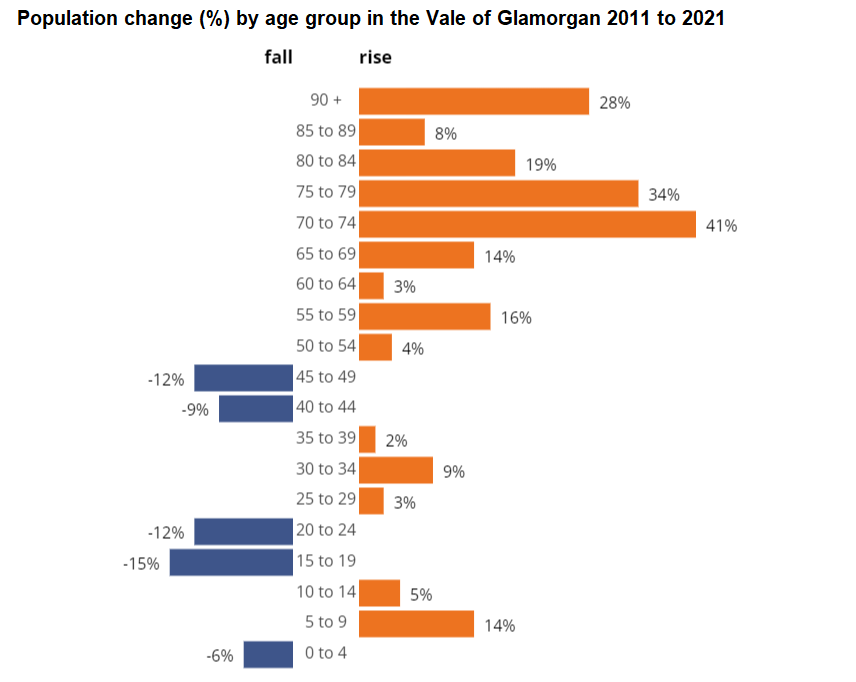
3.13 The largest growth in population (2001–2020) has been in the 65–79 age group with an overall increase of almost 50% (Figure 4). The 80+ age group has also seen substantial growth, increasing by 38% over the historical period. The size of the working age population (15–64) has increased by 10%, whilst the population aged 0–4 has decreased by 2%. The population ageing seen in the Vale of Glamorgan is an inevitable feature of population change across the UK, as the larger birth cohorts of the post-war period move into the retirement ages and improvements in healthcare mean people are living longer. There have been some significant changes to the demographic structure between 2011 and 2021, with the 65 years and older population increasing by 24.9%. This is significantly higher than the Wales figure overall, where the 65 and older population has increased by 17.7%. The 15 to 64 years population in the Vale has decreased by 1.5%, which is lower than the Wales figure of 2.5%, but the younger population (15 and below) has increased by 4.3% compared to a decrease of 1% in this age group in Wales overall.
Source: ONS
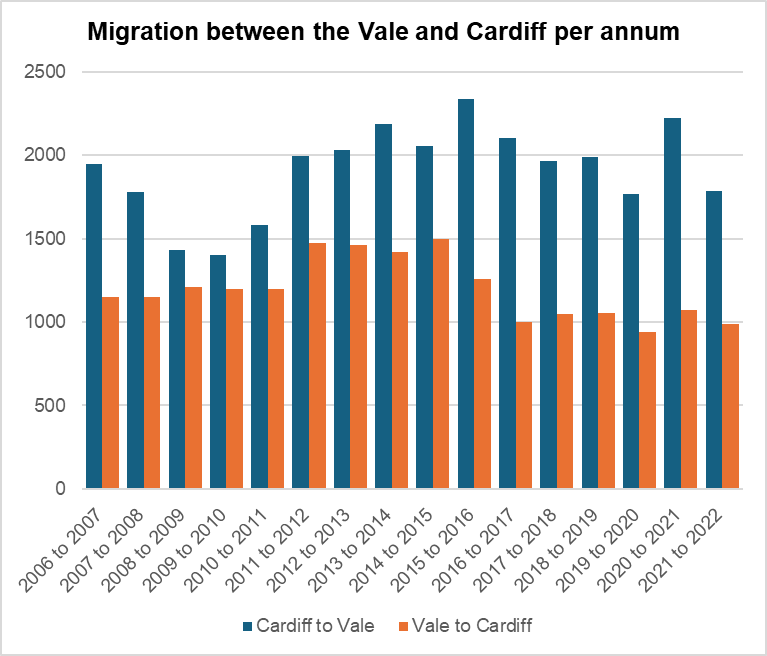
3.14 Migration data for the Vale of Glamorgan indicates that the largest population exchange (inward and outward migration) has occurred between the Vale and neighbouring Cardiff. This is illustrated in Figure 5, which indicates that there has been a steady exchange of people moving between Cardiff and the Vale, with the Vale experiencing a net increase in its population (an average of 716 per year) due primarily to a significant net migration flow from Cardiff. This has been a key contributing factor for the ‘above Wales average’ population increase identified within the 2021 census.
Source: ONS
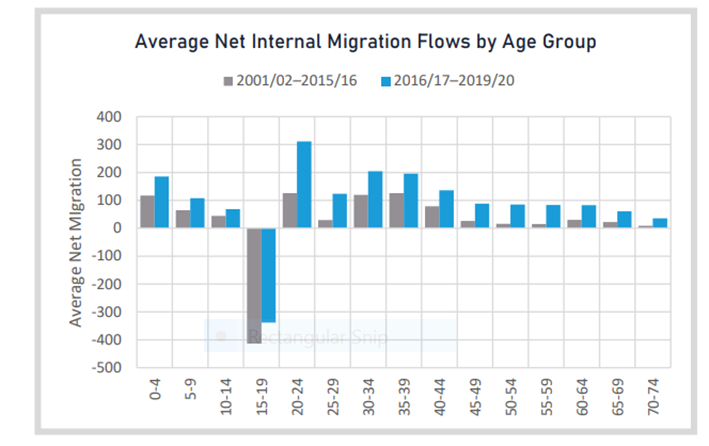
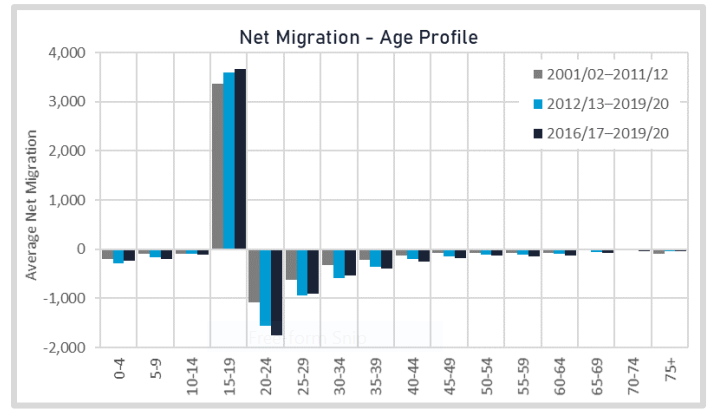
3.15 The population exchange between the Vale and Cardiff has also influenced the demographic profile of both authorities. Figures 6 and 7 highlight that since 2001 there has been a net inflow into the Vale across all age groups, except for the 15–19-year-old cohort, as family groups in particular have moved into the Vale from places such as Cardiff. Conversely, there has been a large outflow associated with young people leaving the area to study elsewhere in the UK. This is also reflected in the inward flow of 15–19-year-olds into Cardiff.
Source: ONS
Source: ONS
Housing Market and Housing Need
3.16 The long-term migration trend of people moving between Cardiff and the Vale suggests that the Vale and Cardiff, to some degree, share a larger than local housing market, and to a lesser extent this is also shared with neighbouring Bridgend. These factors highlight the importance of collaboration between the Vale and its neighbours when considering strategic matters such as housing growth.
3.17 The Vale has the highest affordability ratio in Wales with average house prices in 2023 on average 9.7 times the average workplace earnings compared to the Wales average of 6.1[2].
3.18 Consequently, the Vale has a significant need for affordable homes, with affordable housing need remaining one of the highest in Wales, even though the Vale is one of highest performing authorities in Wales in terms of affordable housing delivery. Using the principal projections, the Council’s 2023 Local Housing Market Assessment (LHMA) identifies a need for 1,075 affordable homes per annum over the 5-year period 2023-2028 and 154 affordable homes per annum for the following 10 years. The LHMA also includes variant scenarios to assess the need based on population growth in line with the RLDP projections rather than the WG 2018 principal projections. In the RLDP scenario, the need is 1,114 affordable homes per annum for the first 5 years, and 196 affordable homes per annum for the 10 years after. The LHMA highlights that the areas in the Vale with the greatest need are Barry and Penarth/Llandough, however there is a need for a range of types and sizes of affordable housing across all housing market areas in the Vale.
3.19 There is significant pressure on temporary accommodation in the Vale, for a variety of reasons including increased homelessness presentations (driven in many cases by the cost-of-living crisis), as well as the Council’s duties and commitments in respect of resettlement programmes. The need for sufficient permanent affordable housing to assist in moving people out of temporary accommodation is critical and the planning system has a vital role in assisting in new affordable housing delivery.
Gypsy and Travellers
3.20 The Council has a duty to ensure that the existing and future accommodation needs of the Gypsy and Traveller community is met through the provision of sufficient land in the RLDP for Gypsy and Traveller sites. The latest Gypsy and Traveller Accommodation Assessment (GTAA) identifies an unmet need for pitches in the short term and longer term.
Health and Well-being
3.21 The Vale of Glamorgan is generally regarded as an affluent and attractive area within the region. However, the Vale exhibits considerable socio-economic diversity. Parts of the rural Vale contain some of the most affluent communities in Wales, while other communities, particularly in urban areas, fall within the highest 10% of most deprived areas in Wales.
3.22 The Welsh Indices of Multiple Deprivation (WIMD) show that the most deprived neighbourhoods in the Vale have persistently been in Barry, primarily within the eastern wards. The most recent WIMD data (2019) identified 3 areas in Barry within the top 10% most deprived places in Wales (Gibbonsdown 2, Buttrills 2, and Court 3), with other areas in Barry also falling within the top 20%. In addition, pockets of high deprivation are also present in areas of Penarth, St Athan and Llantwit Major.
3.23 These disparities are reflected in the health and well-being of our communities. When compared to other parts of Wales, Vale residents generally exhibit good health and have one of the highest average life expectancies at birth for both males and females, as well as one of the highest healthy life expectancies in Wales. However, in the areas of highest deprivation, life expectancy for people is considerably lower, where a higher proportion of people are affected by long term health conditions.
3.24 Recognition of these inequalities, which give rise to differing community needs at a neighbourhood and locality level within the Vale of Glamorgan, will necessitate bespoke and holistic approaches that go beyond the remit of the RLDP. However, the plan can assist in addressing these issues through enhancing access to employment, improving open spaces and public transport and active travel routes, and supporting the provision of affordable housing and regeneration.
3.25 Access to health and social care services is a more challenging issue for some parts of the Vale, particularly given the ageing population, and in rural areas where there is more challenging access to public transport. In preparing the RLDP, the Council has worked closely with the Cardiff and Vale University Health Board to identify future health and well-being issues and to ensure that health is a key consideration in the policies of the Plan.
Education
3.26 The Vale is served by 44 primary schools, which includes 10 Church in Wales primaries, 2 Roman Catholic primaries and 6 Welsh Medium primaries. There are six English Medium secondaries, one Welsh Medium 3-18 school and a Roman Catholic Secondary. There is one Special School, which has a main base but also operates from several satellite sites.
3.27 A number of new primary and secondary schools have been developed across the Vale as part of the Sustainable Communities for Learning Programme (previously known as 21st Century Schools), with further plans as part of the programme progressing. This includes replacement schools with increased capacity at St Richard Gwyn Catholic School in Barry (secondary), Ysgol Gymraeg Iolo Morganwg in Cowbridge (primary) and increased Additional Leaning Needs (ALN) provision at Ysgol Llyn Derw at Cosmeston. In preparing the RLDP, the Council has considered educational needs arising from planned growth, especially within those areas where capacity is limited.
3.28 Cardiff and Vale College is also located in Barry, with planning permission for new campuses at both Cardiff Airport and Barry Waterfront.
Connectivity
3.29 The area benefits from good road and rail links that provide direct connectivity to the wider region. The M4 motorway located to the north of the Vale provides a key transport link that gives access to the South East Wales region and beyond. The Vale of Glamorgan railway line runs east to west through the authority serving the Vale’s largest settlements of Dinas Powys, Barry, Penarth (Cogan), Llantwit Major and Rhoose, linking the authority with Cardiff and Bridgend and providing connections to the main south Wales railway line. There is also a branch line between Penarth and Cardiff, providing frequent connectivity. The main towns also have reasonable access to local bus services, but villages that are located away from key bus corridors are less well served.
3.30 Cardiff Airport is located near the coast to the west of Barry. Recognised as an important gateway for business and tourism in south Wales, the airport plays a significant role in supporting the local economy and connecting South Wales to destinations across the UK and the world. Since the outbreak of the Coronavirus pandemic in 2020, the number of passengers using Cardiff Airport has fallen sharply. In 2024, passenger numbers stood at 881,000 (arrivals and departures), which is below the pre-pandemic levels of 1.65 million in 2019. The proximity to the airport offers significant benefits and opportunities and should be capitalised on through the plan.
3.31 The nature of the Vale’s settlement patterns means that residents within the main towns and settlements are better able to access a range of facilities by walking, cycling and public transport, and the Council continues to improve the active travel network within and between settlements. However, there is relatively limited public transport availability in the more remote rural areas and between those areas and the main towns. This limits accessibility to facilities and services, particularly for disadvantaged groups.
3.32 The Vale of Glamorgan is within the South East Wales Metro Zone and the Council continues to seek to improve public transport connectivity to improve transport infrastructure.
3.33 The Port of Barry is a key facility for the region's chemical industry, handling liquid bulk cargo for major chemical companies. The port handles around 300,000 tonnes of cargo, contributing over £340 million to the economy every year and is an important source of local employment.
3.34 Digital connectivity will continue to play a significant role in enabling agile working and facilitating economic growth. Data from WIMD 2019 provides an insight into the quality of broadband availability across the Vale of Glamorgan. The WIMD Environment Domain includes a measure of the unavailability of broadband at speeds of 30 megabits per second (mbs), which is the typical speed provided by Fibre to Cabinet connections. There is a disparity in download speeds between more rural and urban areas of the Vale of Glamorgan. Towns such as Barry, Penarth and Cowbridge show high availability of broadband at 30mbs and LSOAs in more rural areas show poorer availability. The RLDP will promote and support the delivery of digital and communications infrastructure to meet the needs of users and providers for the plan period.
Economy & Employment
Place of Work and Commuting
3.35 The geography of economic activity within the authority is increasingly varied, with Vale residents often living, working and taking part in leisure activities both within and outside of the authority. Since the Covid pandemic, the number of people working from home has increased significantly, alongside the proportion of the workforce who participate in flexible work patterns. The latest 2021 Census data indicates that 34% of the workforce work from home either part or full time, although this should be treated with caution due to the timing of the Census in respect of the Covid pandemic. The figures vary across the Vale of Glamorgan, with highest occurrences of homeworking located within the rural Vale, and the lowest within Barry[3].
3.36 Whilst the distance residents typically commute is relatively short, with most Vale residents (33.8%) travelling less than 10km to their place of work, 16% commute up to 30km and 3.5% more than 30km. Levels of outward commuting remain relatively high.
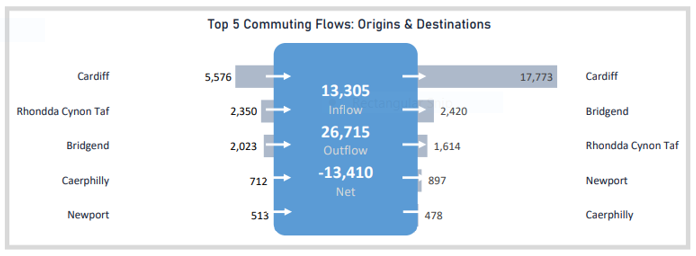
3.37 The 2011 Census showed that 48% of working residents in Vale West and 43% of wording residents in Vale East work within the Vale. Of those commuting outside of the Vale, the majority were travelling to Cardiff with other notable flows to Bridgend and Rhondda Cynon Taf (Figure 8).
Source: ONS 2011
3.38 The 2011 Census indicated that 72% of residents travelled to work driving a private motor vehicle, with 10% by public transport, 9% on foot, 2% by bicycle and 6% as a passenger in a car. The 2021 Census showed a slight increase in car usage (77%) and a decrease in public transport (6%), but figures may be affected by the pandemic.
Employment Structure
3.39 The proportion of the Vale’s working age population (16-64 years old) in 2021 was 60.3%; slightly below both regional and national averages (62% and 61.2% respectively).
3.40 Over the past 5 years, the number of jobs within the Vale of Glamorgan has generally remained constant at over 41,000. The job profile of people employed within the sector has changed, with the greatest change occurring within the professional, scientific and technical sectors, and business and support services, reflecting the wider trend in the expansion of office-based employment.
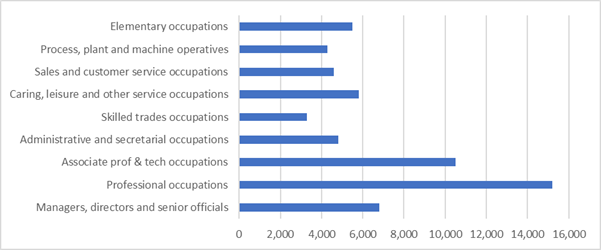
3.41 The health sector accounts for the largest number of employees within the Vale of Glamorgan, with 8,000 or 19.5% in employment in this sector. Manufacturing was the next largest industry in the Vale of Glamorgan, employing 3,500 or 8.5 percent of the workforce. The private office sector accounted for a combined total of 15.4 percent, or 6,300 employees in the Vale, compared with 16.8 percent for Wales. Due to the high prevalence of residents employed in professional sectors, the Vale can be described as having a skilled workforce, which is reflected in average weekly pay in the Vale being £61 more than the average workplace weekly pay, equivalent to 10% more[4]. Agriculture, forestry and farming make a small but important contribution to the economy in the rural Vale, providing 800 jobs, or 2% of employment.
Source: Annual Population Survey, 2022
Tourism
3.42 The Vale has a range of attractions for tourists that utilise the natural environment to improve the area’s economic well-being. This includes the Glamorgan Heritage Coast; the Wales Coast Path; well-established seaside resorts; attractive countryside and country parks; unique historic features; a range of outdoor pursuit activities; and a well-established network of Public Rights of Way.
3.43 Barry Island seafront and Whitmore Bay are recognised as the main tourist destination within the Vale of Glamorgan. The resort is well known throughout the South Wales Valleys, South West England and the West Midlands from which historically a high proportion of visitors were drawn. The resort’s main attractions include the beach, Barry Island Pleasure Park, other smaller attractions and numerous amusements, cafes and bars.
3.44 The economic contribution of the tourism sector is significant, with 2023 STEAM data indicating that the total economic impact of tourism was worth £327.89 million with 2,970 FTE jobs supported by tourism spend and 4.05 million visitors. There are significant numbers of day visitors and staying visitors, but the figures are still slightly below pre-pandemic levels.
Retail
3.45 The retail sector in the Vale of Glamorgan is made up of a range of convenience and comparison stores centred primarily in the settlements of Barry, Penarth, Llantwit Major and Cowbridge, and at the out of centre retail park at Culverhouse Cross. Health checks on the main town centres undertaken as part of the Retail and Commercial Leisure Study (2023) indicated that Penarth, Cowbridge and Llantwit Major were performing well, with below average levels of vacancy rates within the district centres. However, the town centre of Holton Road in Barry and the District Centre of High Street had higher than average vacant units. There is a need to ensure that future policies allow for flexibility for a greater range of uses that would be acceptable within a town centre, in line with the town centre first principle and the need to create vibrant places.
3.46 The retail study identified that the Vale of Glamorgan is retaining a healthy proportion of spend on convenience goods, with 86.1% (£275.7m) of all convenience spending (everyday essential items such as food) by Vale residents being in retail units within the Vale. However, much of this spend is taking place within out of centre stores rather than town centres. For comparison shopping (retail items not bought or a frequent basis), the Vale retains just over half (50.3%) of all comparison spend (£294.5m), with the leakage out of the area being primarily directed towards Cardiff.
3.47 The study identified that there is a convenience floorspace capacity of between 4,282 sqm and 5,862 sqm (depending on the type of operator), which is due to the trading of existing stores above benchmark levels. In qualitative terms, Barry Holton Road, Penarth, and Llantwit Major town centres have been identified as having a need/consumer capacity for a medium to large supermarket, in line with the town centre first policy.
Natural Environment
3.48 The Vale is a distinctive, gentle lowland landscape, largely comprising a rolling limestone plateau, which is dissected by several rivers including the Ely, Thaw and Waycock. A variety of rural land uses characterise the area, reinforced by thick hedgerows, frequent small woodlands and areas of trees, which create a sense of enclosure. The landscape terminates abruptly at the Heritage Coast with vertical cliffs. Dispersed between the cliffs there are several sandy and shingle beaches along the coastline.
3.49 Many of the Vale’s landscapes are identified through designations for their high quality. One Landscape of Outstanding and Special interest exists wholly within the Vale and another partially. There are 6 Special Landscape Areas, and the western coast of the Vale is recognised for its national importance as the Glamorgan Heritage Coast.
3.50 The mixture of coast and countryside landscapes results in a wide variety of habitats, some of which are quite rare such as the mesotrophic lake, Pysgodlyn Mawr, at Hensol and the saline lagoon at Aberthaw. This diversity also means that the Vale’s coast and countryside hold a rich diversity of flora and fauna. Rare species are present, including the High Brown Fritillary butterfly, the Green Sandpiper, Corn Buttercup, the True Service Tree, the Fairy Shrimp and the Shrill Carder Bee. Whilst the extent of many of the habitats is relatively small, some are more extensive such as heathland, coastal grasslands and woodlands, and the length of ancient and species rich hedgerows and arable field margins are significant.
In recognition of the rich habitats of the Vale, many of its areas are designated for their biodiversity value by international, national and local designations, making it one of the richest areas of biodiversity and natural beauty in South Wales. There are 2 sites in the Vale designated as European sites under the Habitats Directive: the Severn Estuary, which is identified as a RAMSAR site, a Special Area of Conservation, and a Special Protection Area; and Dunraven Bay, which is identified as a Special Area of Conservation. The Kenfig Special Area of Conservation also abuts the Vale to the East. In addition, there are a range of national and local designations including 27 Sites of Special Scientific Interest; over 300 Sites of Importance for Nature Conservation; 12 Regionally Important Geological and Geomorphological Sites, and 3 Local Nature Reserves. It is important to safeguard these designated areas and where possible take advantage of opportunities to create new ecological networks.
3.51 The adopted LDP identifies green wedges which seek to prevent the coalescence of settlements and retain openness. These green wedges have been reviewed in line with a regional methodology for the identification of green wedges. Consideration has also been given to the existing Special Landscape Area designations to ensure that these remain appropriate.
Language, Culture, Heritage, and Diversity
3.52 The Welsh language is part of the social and cultural fabric of Wales, and the Welsh Government is committed to ensuring that the Welsh language is supported and encouraged throughout Wales. The 2021 Census identified that 11.5% of the population aged 3 or older could speak Welsh, representing an increase compared with the 2011 Census, where only 10.8% of people aged 3 or older could speak Welsh. This is contrary to the trend experienced across Wales overall, where the number of Welsh speakers has decreased from 19% in 2011 to 17.8% in 2021.
3.53 The percentage of people recording that they are from a non-White ethnic group has increased in the 2021 Census compared to the 2011 Census, with 5.4% identifying as belonging to an ethnic group other than White, compared to 4.4% in 2011. The 2021 Census identified that 2.1% of the population identified their ethnicity as ‘Asian, Asian British or Asian Welsh’, 0.5% identified as ‘Black, Black British, Black Welsh, Caribbean or African’, 2.3% identified as ‘Mixed or Multiple ethnic groups’ and 0.5% identified as ‘other ethnic group.’
3.54 In terms of built heritage, the Vale of Glamorgan has approximately 740 listed buildings, over 100 Scheduled Ancient Monuments, 39 Conservation Areas, 18 areas included in the Register of Historic Parks and Gardens and 2 areas on the Register of Landscapes of Historic interest in Wales.
Climate Change and Flood Risk
3.55 In 2019, the Vale of Glamorgan accounted for approximately 5% of Wales’ carbon emissions with 1,113ktCO2. Due to reductions in industrial emissions, primarily the closure of Aberthaw Power Station, emissions have reduced significantly to 550ktCO2 in 2023. However, emissions remain high in the Vale, and per capita emissions at 4.2tCO2, are above the Welsh average of 3.6tCO2. Therefore, whilst emissions have reduced significantly, the closure of Aberthaw Power Station is an ‘easy win’ and more, perhaps harder, reductions are required over the Plan period to ensure progress to net zero is made. As of 2023, the sectors that emit the most carbon are buildings (45%) transport (30%) industry (14%) and electricity generation (11%). Buildings are now the Vale’s greatest source of carbon emissions and 53% of the Vale’s housing stock have an EPC rating of D or worse. 38% of the Vale’s electricity demand is met by local renewable energy generation, with ground-mounted solar PV (84MW) and biomass (45MW) contributing to this.
3.56 As a coastal authority climate change will have a dramatic impact on the Vale’s coastline and the communities within coastal areas due to sea level rise and storms leading to increased exposure of the coast to flooding and coastal erosion. Also, areas of the Vale are within proximity to existing areas of flood risk, particularly areas neighbouring Barry, Dinas Powys and Penarth. Natural Resources Wales Communities at Risk Register estimate that there are approximately 5,000 residential properties in the Vale currently at some level of flood risk[5]. General climate change projections show an increased likelihood of more frequent and intense rainfall. It is expected that severe events such as the 2020 storms will become more common with increased severity and frequency of flooding of homes, communities, and businesses. At the same time, coastal flooding is a growing threat due to accelerating mean sea-level rise and increases in storminess and wave heights. These climate change associated impacts will increase the number of properties, infrastructure, and key services at risk of flooding from all sources.
[3]https://www.ons.gov.uk/employmentandlabourmarket/peopleinwork/employmentandemployeetypes/bulletins/traveltoworkenglandandwales/census2021
